What happens when people can read, but can’t access information in a language they understand?
For Communication Directors working across borders, literacy is about more than the ability to read and write.
It’s about access, understanding and participation.
An NGO can produce an excellent report.
A government agency can publish vital guidance.
An international organisation can launch a global campaign.
But if the message isn’t accessible to the communities it is intended to reach, its impact is limited.
🌍 This is where language access becomes part of the communication strategy.
Effective multilingual communication requires more than translating words. It means considering:
🔹 Audience — Who needs to understand the message?
🔹 Context — Will the meaning work culturally and locally?
🔹 Accessibility — Can people easily access and understand the content?
🔹 Consistency — Is terminology aligned across languages and channels?
🔹 Speed — Can multilingual content be delivered when it matters?
🔹 Quality — Is the message accurate when the subject is sensitive or complex?
For organisations working in development, education, healthcare, human rights and humanitarian response, these questions can directly influence the reach and effectiveness of a programme.
At Prime Production Ltd, we help organisations combine specialist human translation, controlled AI-assisted workflows, terminology management and professional interpreting to deliver multilingual communication at scale — without losing the human understanding behind the message.
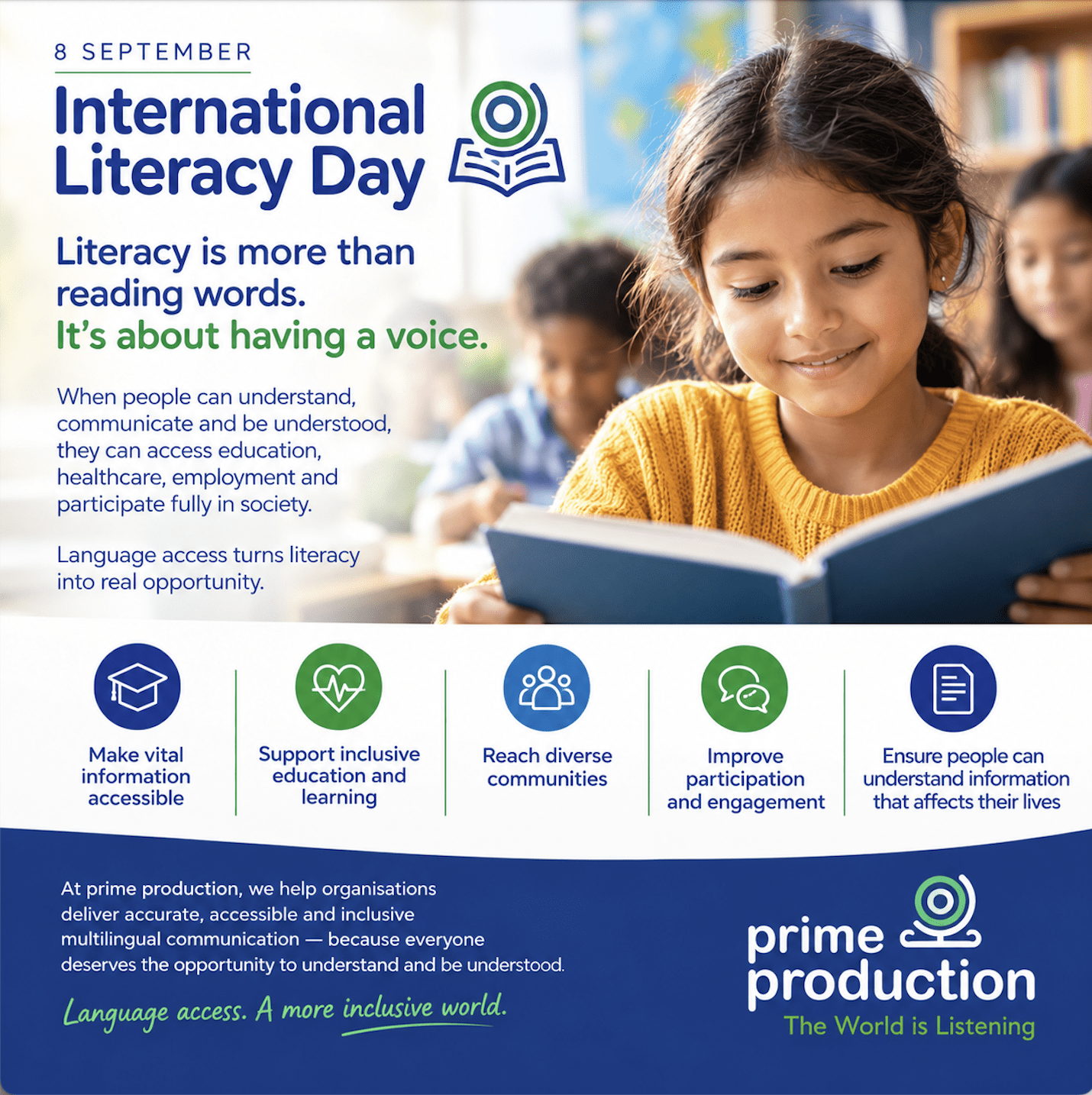
Because literacy is not simply about being able to read the message. It’s about having the opportunity to understand it, act on it, and be part of the conversation.
This International Literacy Day, let’s make language access part of the communication strategy — not an afterthought.